February 4, 2026
Born October 4, 1923, Martha Kerr Glymph went by her maiden name for a mere 19 years of her 101 years of living. Once she married our dad, Homer Lindell Riley, she became Martha Glymph Riley for the rest of her life. That name, however, played a role in her development growing up.
She was the eighth born of nine children to Grover Cleveland Glymph, Sr. and Mary Kelly Glymph. Glymph is a singular name linked to a small number of Glimpf ancestors who had immigrated from Germany to Pennsylvania in the mid-1800’s. They soon migrated to South Carolina. Most of the 11,000 or so people who go by that name today live in South Carolina or Georgia. At one time, there was a township called Glymphville, SC. It has since disappeared from the map. Having a family name so unique and foreign in a small Southern town such as Durham helped define her in many ways. Of course, she and her siblings were teased endlessly at school for their strange surname in a world of Smiths and Joneses.
Her parents moved from South Carolina to Durham for a better opportunity. Mr. Glymph was an insurance salesman, a professional in a city of textile mills and cigarette factory workers. The fact that many of his customers lived on the neighboring streets in West Durham had a lot to do with the stern manner in which Martha and her siblings were raised. Appearances mattered to Mr. Glymph, and he saw to it that his kids set an example of good behavior that would reflect on him and his business.
Often, Mr. Glymph would pack a few kids in his car, and they would ride along, seen but not heard, as he collected insurance premiums from customers or sold new policies door-to-door. He would often tell the kids a bit of the story of a family he called on, giving them a broader understanding of life, troubles, and the financial security insurance provided.
In 1920, the Glymph’s bought a relatively new home at 2040 Englewood Avenue. It was one of the first built on the newly laid-out street. It still stands today, listed in the registry of Historical Homes in Durham.
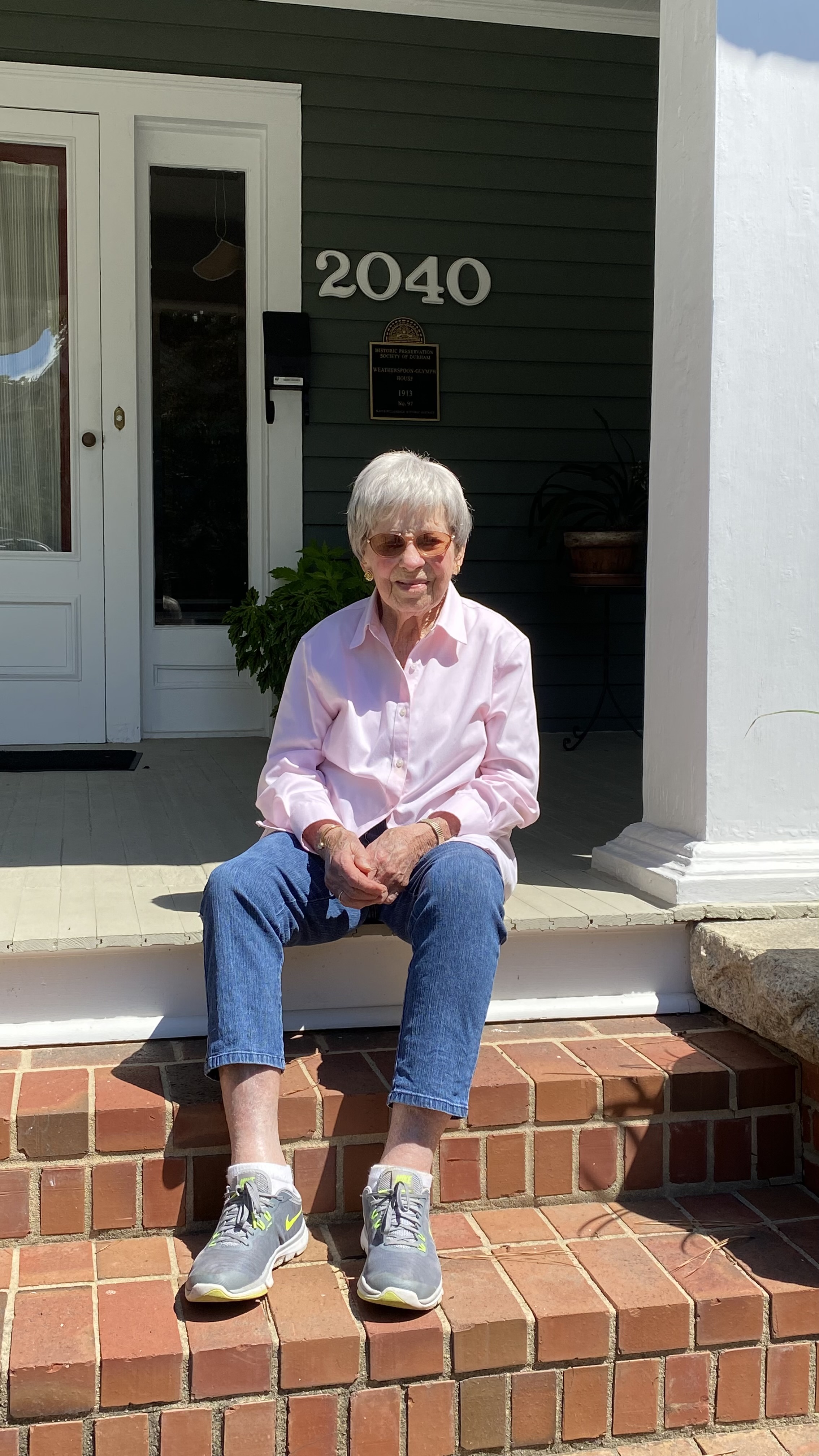
For over a century, 2040 provided Mom with a solid foundation and deep roots. Through the years, it meant so much to her to be able to swing by her house on a whim and take a quick peek, or stop in for a quick visit with her folks. If you were riding with her, she’d share a few of her memories: the front porch swing where she and Daddy courted, the second-floor window to her bedroom that she shared with her older sisters, and their corner of Englewood and Carolina Avenues. She cherished her neighborhood and the childhood friends who grew up there with her. She could go up and down the street, naming the families who lived in each house. It’s where she was born, where she lived when she first met Homer when she was 13, and where they were married on June 19, 1943, right before Dad was transferred to Camp Pendleton outside of San Diego for his final training before shipping out for action in the Pacific in World War II.
She left 2040 for the first time to follow Homer to California. As a 19-year-old, she had never really been outside of Durham, yet she bought her train ticket with savings from her job as a clinical technician at Duke Hospital, boarded by herself, and traveled over four days to get to Oceanside, California. The train was loaded with military. “Those young boys heading off to war treated me like royalty,” she said about her trip. “I don’t know how I would have made it without their kindness.”
Mom returned to Durham after Dad shipped out and waited, hoped, and prayed for his return. And when he did, faced with the choice of going right to work as a plumber or taking advantage of the GI Bill and going to college, she urged him to choose college. She believed in Homer so much that she would do anything to help him get an education that could set them on the right path for a happy and fruitful family life. Together, they would make ends meet.
Mom was very proud of her hometown, and there was never any question as to where she wanted to live and raise their family. Except for that brief stint in Oceanside, CA, and part of a year in Gatlinburg, TN, she and Dad lived their whole lives in Durham.
She loved the life they made for themselves in this small, personable town. She could quote chapter and verse about the names and stories of so many of the important people who made Durham. She read the Durham papers every day to keep up with current events and occurrences in her town.
Mom confided in me quite a few times over the years that she never thought she was very pretty or smart. She envied her neighbor and lifelong friend, Mary Beavers, for her good looks and poise. When I stand back and look at my mom’s pictures from her early years, I see that she sold herself short. She might not have been a movie star, although she could have been. But you can’t argue with how someone feels about themselves.
The good news was that it never stopped her from doing anything. Whether it was a huge occasion or meeting people for the first time, she met the moment. You’d never sense that she had any insecurities. Maybe telling me her honest opinion of her physical characteristics wasn’t a show of insecurity. Maybe she was just a person who looked in the mirror and didn’t always appreciate what she saw. After she turned away from that mirror, she moved on, not thinking about herself as much as she thought of others and whatever was going on in her world, or the world at large. Plus, one thing in which she was always sure was the love and dedication she shared with her Homer.
Growing up in a big family with older brothers, she had a zest for playing games normally played by boys, like softball and street hockey. She also loved playing tennis at Oval Park with her friend Caroline, who lived next to the clay courts.
Homer said he loved her for all that, her competitiveness, her “fun-loving” ways, he’d say, closing his eyes and remembering their childhood together.
“Yeah,” he said. “She was a bit of a tomboy, but she was all girl. She loved to have a good time. Always has, as long as we’ve been together.”
For all of her tomboyishness, man, oh man, did she love the color pink. When they built their house on Indian Trail, her kitchen floor was pink linoleum tile. Her oven, counter tops, stove top, and refrigerator…all pink. And to top it off, her kitchen ceiling was wallpapered with a small floral pattern of tiny, soft pink rosettes with splashes of light green leaves. I remember lying on the floor in the kitchen, looking up at that ceiling and thinking what a touch that was, something floating over our heads, most likely never noticed by visitors.
Oh, and her master bath was pink tile, sinks, tub, and toilet. Pink, pink, and pink on pink!
She loved to dress up “for show,” as she called it. Sparkles abound. And, most often, there was pink sprinkled in there somewhere.
On this, the first anniversary of her death, thank you for spending some time with some of the stories of her life. I’ll close with a few “Martha” quips. I call them “Martha-isms.”
“Mom,” I said as I pushed her in her walker through the long, up-and-down hallways of Croasdaile Village.
“Yes, Steve.”
“Everybody here at Croasdaile Village knows you.”
“I know. And I have a terrible reputation.”
“Can you believe I’m almost a hundred?” she said to me when she was 99. And before I could reply, she said, “I guess all that drinking didn’t hurt me.”
Mom looked around the room of all of her family of children, grand and great-grandchildren, then looked over at me, shook her head, smiled, and said, “Take my membership out of this group!”
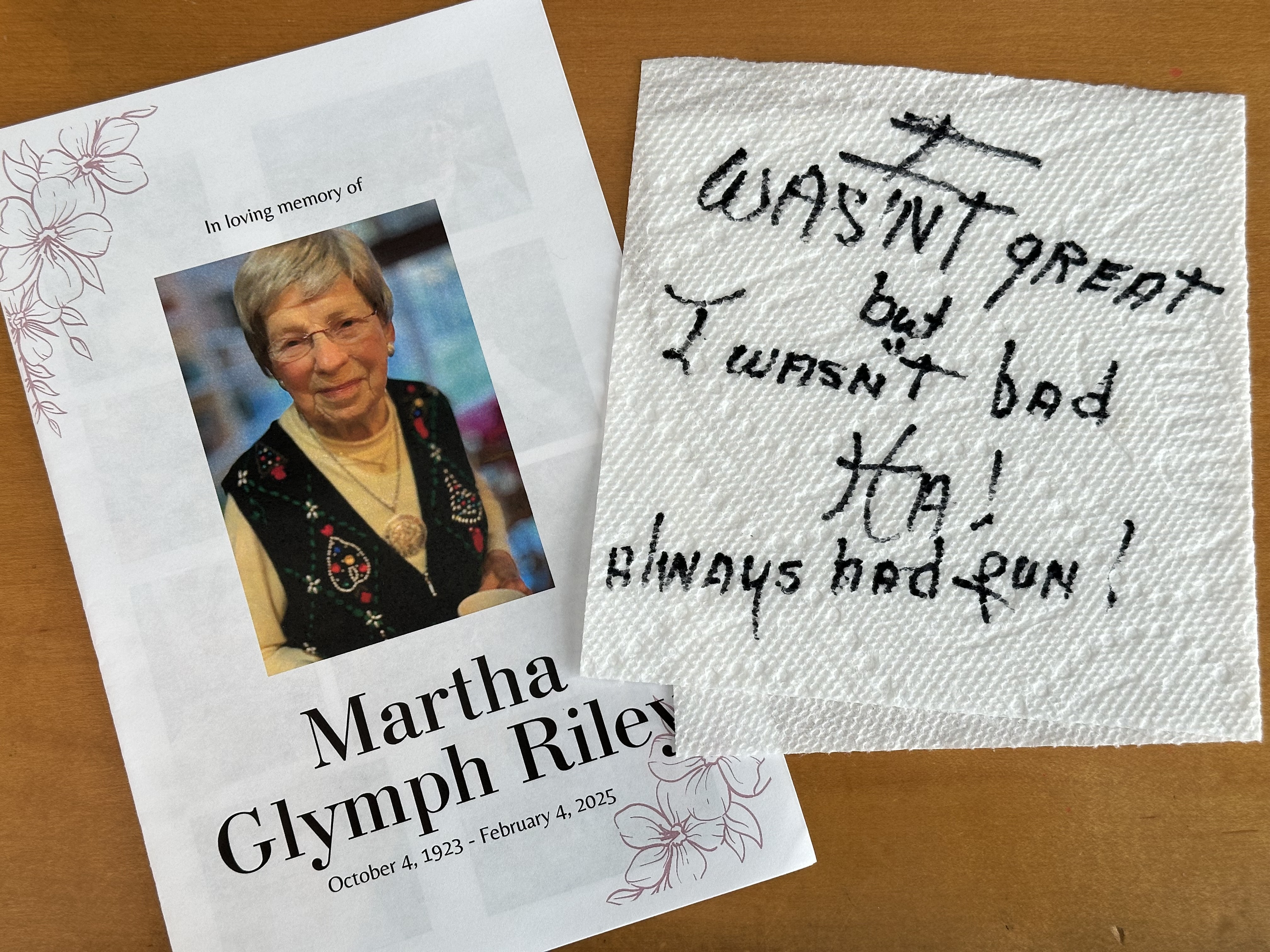
She wrote, in black Sharpie, on a piece of paper towel, what could have been her epitaph, “I wasn’t great, but I wasn’t bad. Ha! Always had fun!”
I found that paper towel lying around with a collection of photos and odds and ends. I believe she wrote it down, first to amuse herself, and then decided to leave it there for someone going through her stuff to discover. She wanted them to know what she thought of herself.


 Life of Riley